Showing posts with label Genesis. Show all posts

Wednesday, July 10, 2013

Biblical Poetry: Genesis and the Creative Drive


Wallpaper - Dark Ocean
I've been working on revisions to a YA novel of mine, and it has reminded me how much truly beautiful poetry can be found in the Bible.  Take, for example, the opening lines of Genesis, which provide a magnificent description of the first moments in the creative process:

In the beginning God created the heavens and the earth.
Now the earth was formless and empty,
darkness was upon the surface of the deep
and the Spirit of God hovered over the waters.

What a stirring description of the start of everything, and the initial stages of any creation.  You begin with raw material that is formless and empty.  The depths that you will explore in the creative process remain in darkness, and the creative spirit, the creative urge, hovers over it all.

Next time you sit down to begin a creative endeavor of any sort, think back on these lines.  For me, they serve as a reminder that our creative drive connects us to something much greater, beyond ourselves, and deeply ancient.    


Saturday, January 26, 2013

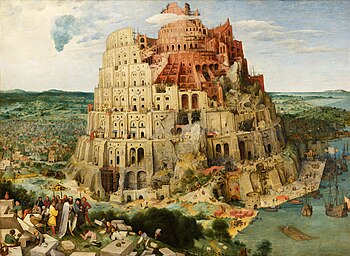
Revisiting the Tower of Babel

In my other blog (Writer's Wavelength), I referred to twitter and other social media as a new Tower of Babel.  That got me thinking about the Biblical story behind that phrase.  The story is in Genesis Chapter 11.  The community of man, with one language, working together, builds a tall tower.  "Come, let us build ourselves a city, with a tower that reaches to the heavens, so that we may make a name for ourselves and not be scattered over the face of the whole earth," they say.  Then God sees it and says, "If as one people speaking the same language they have begun to do this, then nothing they plan to do will be impossible for them."  So He decides to confuse their language and scatter them over the world.

The image of God here, as in so much of Genesis, is a little troubling.  He seems spiteful, much like in Eden.  "Uh-oh.  They're getting too much like me.  Can't have that!"  Why not?  If humanity is made in God's image, if God wants us to strive to be pure and good, to be like Him and therefore worthy, why not celebrate the way His children are reaching, the way they are working together towards a common goal?  Worse, God seems to inherently mistrust his children, assuming that being able to accomplish whatever they put their minds to is automatically a bad thing.  (Knowing human beings, God is right about this.  If we could accomplish whatever we planned without struggle and effort, it might lead us down a very dangerous and destructive path.)

The story is often interpreted as a cautionary tale about hubris, much like Daedalus and Icarus in Greek mythology, who were punished for flying too near the sun.  I think there's a subtle difference.  The key is in the phrase "so that we may make a name for ourselves."  The people building the tower aren't seeking divinity; they're seeking fame.  They also seem to be seeking the common good of togetherness ("and not be scattered over the face of the whole earth"), but their primary aim appears to be getting noticed.  Celebrity.  Narcissism.  Vanity.  Perhaps this story calls upon us to examine every lofty human endeavor through this lens, questioning whether the motives are altruistic or narcissistic.

What's also interesting to me, though, is God's absolute certainty that, if human beings  can easily communicate with one another and work together "as one people," then "nothing they plan will be impossible for them."  There's something oddly hopeful in that, a kind of confidence.  After all, God thinks we can literally accomplish anything we put our minds to if we work "as one people" with a common language.  What a tremendous statement of the potential of human community!

The story attempts to answer the age-old question "Why can't we all just get along?" while at the same time acknowledging what incredible things we could do if ever we DID get along.  Here on earth, maybe effortless cooperation and communication are no longer possible.  Maybe, the struggle inherent in communicating with one another post-Babel is part of the learning process we must engage in on earth.  Perhaps it makes us better people if we must work to understand one another.  That process forces us to put others first, thereby limiting our inherent narcissism, our desire "to make a name for ourselves."  Maybe striving for community and communication only has value when it comes not from a place of narcissism but merely for the common good.  As St. Francis of Assisi put it, "grant that I may not so much seek to be consoled as to console, to be understood as to understand."  Perhaps that is the true lesson of the Tower of Babel.


Saturday, January 19, 2013

Revisiting Biblical stories you think you know: Cain and Abel

Cain and Abel is another one of those foundational stories of Genesis, the root of the phrase "Am I my brother's keeper?" and the archetypal tale of sibling rivalry, where God is in the role of the parent.  It goes like this:
Abel kept flocks and Cain worked the soil.  Cain brought God an offering from the fruits of the soil, and Abel brought God an offering of fat portions from the firstborn of his flock.  God looked with favor on Abel's offering, but not on Cain's.  So Cain was angry.  God says "Why are you angry?  Why is your face downcast?  If you do what is right, will you not be accepted?  But if you do not do what is right, evil is crouching at your door; it desires to have you but you must master it."
Then Cain takes his brother out into the field and kills him.  When God asks where his brother is, Cain says "I don't know.  Am I my brother's keeper?"  God curses him and says "You will be a restless wanderer upon the earth."  Cain is afraid he will be killed by whoever finds him, so God protects him with a mark.
This story is, in its way, as problematic as any.  After all, Cain does his level best.  He works the soil.  So he brings the fruits of his labors, just like his brother does.  And God turns his nose up at it.  (God, in this story, is obviously not a vegetarian.)  Then, when Cain's feelings are hurt by this, God says, basically, "Get over it."

It's always bothered me that God turns his nose up at Cain's offering.  Why does he do this?  It seems so unfair.  Perhaps that's the point.  There will be times when we will ask, "God, why did you let this happen?  This seems so unfair."  And those are the times when evil crouches at the door and we must master it.

I find myself coming back again and again not to the phrase "Am I my brother's keeper?" or the sibling rivalry in this story but to that phrase about evil crouching at the door.  Some translations say "sin" instead of "evil."  I think "evil" as a word casts a wider net and gives that phrase more resonance.  It's not just the evil that we ourselves may do.  It's the evil that humanity may do.  Evil is always crouching at our door and we "must master it."  What does it mean to master the evil in our world?

Obedience seems to be an important biblical value, at least in the Old Testament.  Case in point, the story of Adam and Eve.  Likewise, Abraham and Isaac (a story I'll write more about in a later post).  And yet, time and again in our lives, we see that to act in a moral way, to master evil, we sometimes must demonstrate disobedience.  Nazi Germany is one powerful example of this.  The Vietnam War is another.  The Civil Rights Movement.  Women's Suffrage.  Over and over again, we learn that sometimes we must disobey a figure in authority because we believe their commands to be morally wrong.  It is not acceptable to claim that we were "just obeying orders."  We are morally aware creatures, and therefore we bear the onus of moral responsibility.  

Of course, there are many disagreements about what is right or wrong in given circumstances.  That's the price of the more complex world that comes with moral awareness, with the knowledge of good and evil.  Evil crouches at our door and we must master it.  We must be able to recognize it and overcome it.  Not a simple task.

I sometimes think "mastering evil" means something more than just stopping it, preventing it.  Mastering evil may also mean finding hope, strength, faith and belief in good even when we are faced with the presence of an evil that has occured, that could not be prevented.  This understanding of the phrase occurred to me as I struggled with the murder of children in Newtown, Connecticut, and I asked "Why?"  We are surrounded by such examples of evil in our world.  Some of them are too great for any one individual to overcome.  How do we make our peace with that? Perhaps mastering evil means believing in the power of good in such situations, believing that striving for good is still a worthy goal.

Evil crouches at your door.  You must master it.

Sunday, January 13, 2013

Revisiting Biblical Stories You Think You Know: Adam and Eve

I've been working on a short story inspired by Genesis.  It's gotten me thinking about Biblical stories that have gotten a bad rap or been misinterpreted throughout the years.  I thought I'd post about a few of them, and I'm starting with the most obvious one.  After all, you might as well begin at the beginning.  Adam and Eve, specifically, the eating of the apple.

I can't tell you how many times when I was in college I heard people reference this story as a demonstration that Christianity and the Bible was, at heart, anti-intellectual.  Now, if you're a thinking person, that struggle between the intellectual and the spiritual is a pretty big struggle, and this story is often at the heart of it, this idea that God is so anti-intellectual that he doesn't want Adam and Eve to eat of the tree of knowledge.

The thing is, it's not the tree of knowledge.  It's the tree of the knowledge of good and evil.  And that's a whole different thing.  The tree of the knowledge of good and evil.  Think about it for a minute.  It's the awareness of morality.  That's what gets Adam and Eve kicked out of paradise.  That's what makes them ashamed of being naked.  That's where all the trouble begins.  The development of morality.

But there's more.  The reason Eve eats the fruit.  Eve gets the biggest bad rap of all in this story, but the reason she eats that apple isn't because she's stupid or easily tricked.  It's not because she's evil (she doesn't even know what that is yet, remember?).  She thinks she's doing the right thing.  She eats it because she sees that it is "good for food, pleasing to the eye, and also desirable for gaining wisdom."  Gaining wisdom.  She's making the best decision she can with the information available to her.  And remember, she doesn't know about good and evil.

It makes you wonder.  If Adam and Eve don't have a sense of right and wrong yet, then why are they punished?  They're punished just for disobeying.  But if they don't know good and evil, then they don't truly know disobedience as a wrong.  To me, this is the part that makes the story troubling.

Still, it's troubling to me in a good way.  It forces me to meditate on the ethical questions of our decisions and choices.  What weight should be given to obedience as opposed to wisdom or nourishment?  What would be involved in decision-making if you had no notion of good and evil?  Why would a loving God want to protect us from the knowledge of good and evil?  Was it an effort to protect the kind of childlike innocence we see in a newborn child?  And why, through the ages, has Eve been given such a bad rap when she was seeking wisdom?  The Bible has many, many other passages that indicate that the search for wisdom is a good thing.

I don't have answers, but I do believe these questions are worth contemplating.  Like Eve, I am seeking wisdom, I guess.  That quest may mean losing innocence, being cast out of a paradise of contentment.  The questions ruffle the smooth waters of the mind.  So be it.  After all, that's how the journey of humanity begins.