I recently came upon this quote from George Elliot while reading Alix Shulman's book Drinking the Rain: "When I buried my youth, I immediately felt 20 years younger." Having turned 50 this year, the quote resonated for me and I found myself asking, "What does it mean to bury your youth?"
Now, I'm not one to get overly dramatic about celebrity deaths. We all die eventually. However, as I was contemplating what it meant to bury my youth, and what it meant to turn 50, Prince died. And I had a reaction. And I tried to suss out what my reaction meant. It wasn't a tearful reaction, but it was palpable. This musical icon of sexual awakening from my teen and young adult years had died. Then I thought back to a moment earlier this year when I saw the new Star Wars movie and they killed off Han Solo. There, too, I had a reaction, one that seemed a bit larger than the moment might warrant. In the case of Han Solo I sobbed. I felt as if a part of my teenage self had been skewered by a light sabre, too. The death scene felt right, as it should be, but it was devastating in a strange way that I couldn't quite explain and that seemed silly when I tried to put it into words.
So when Prince died, while I didn't sob or really get particularly tearful, I did feel a compelling desire to mark the moment, dramatically. I blasted his music and felt it had to be blasted, not just listened to, and the windows of my car had to be rolled down to send the notes spiraling up into the world. I felt I had to wear purple and paisley. I wanted to post lyrics from his songs on my Facebook. Some part of me watched all this and said, "WTF, McGean?"
Is this part of burying my youth? This step by step process of watching idols die and thereby being reminded that none of us are immortal? When those icons of my youth die, it seems some piece of that youthful self goes, too. "What?" she says, suddenly looking up from her high school dances or her spins around the roller rink or her anguished diary entries or endless phone calls with friends or late night college conversations, "What do you mean, dead? Those people don't die, because I don't die. I am now. I am here. Forever."
In fairness, that self had her wake-up call many times over - first when a friend drowned while I was in high school, then in wave after wave of shock and grief during the AIDS epidemic. You'd think she'd have learned this lesson. And yet, she still seems surprised. Back then, she was outraged. Now, she seems to blink, startled, and look about like a small animal that finds itself in the midst of a shopping mall under construction when mere days earlier, it was a nesting ground. "Umm, why is everybody leaving?" she asks, as if she's at some dorm party. "Where are they going? Should I go, too?"She is puzzled, intrigued, confused, and fading. She's fuzzy around the edges. She's lost her relevance but she doesn't realize it. And yet, she still wants to give me things. She wants me to hold on to the parts that matter. She suddenly realizes she has to leave me legacies, she has to make a case for the things she wants me to keep because she's going away and can't be their custodian anymore.
This past summer, I decided to fully embrace the burial of my youth, to take a proactive stance. I remade my home office, where I do most of my writing, by replacing the futon couch, one of the first pieces of "furniture" I had ever owned as an independent young adult, with a magnificent purple love-seat. I rearranged the furniture. I massively decluttered, taking a great many things to Good Will, including many of those talismans of youth that no longer belonged in my life or world. I had several old sculptures I had made but never fired, pieces I had preserved in the safe, dry world of my home over twenty years and multiple moves, including one nude of a former boyfriend and lover. I chose a couple to keep, pieces that still truly spoke to me. The rest I placed in carefully chosen empty pots in my garden, knowing that Portland's rainy season would slowly and organically wear down the unfired clay, which it did, gradually transforming the pieces into shapeless lumps, and that process felt right.
I went through piles and piles and piles of papers and files - well more than twenty-years worth. It was an emotionally wrenching and exhausting task that is not yet finished but allowed me to free up space, physically and psychologically. I went through my bookshelves and gave away piles of books and carefully curated those I held onto. I took things off the walls and hung new things, putting the old art into storage or giving it away. I took photos of a few things I wanted to remember, while letting go of the physical objects themselves. This herculean effort had the complete support of my beloved husband, who helped me find new things and held my hand and gave me hugs as I trudged through the most draining parts of the effort.
When all was said and done (at least, done for now), I had created a
soul space that felt so inviting, so warm, so energizing, so healthy, so
right for me now that I want to hang out there all the time. It has become a place of creative renewal, a place for healthy reflection and centering, a place of safety and of comfort against new storms. Without ever having made a resolution to do this, I managed to create something externally that met a deep and urgent internal need. I buried my youth and gave it a proper send-off, and in the process, as Elliot implied, I found myself lightened and reinvigorated.
Showing posts with label death. Show all posts
Showing posts with label death. Show all posts
Sunday, January 1, 2017

Monday, November 24, 2014
A Sacred Responsibility: Grieving a Class Pet
Nearly six years ago, I began a remarkable new phase in my teaching journey. My students made it happen. They decided they wanted to earn a class pet. They could have chosen all sorts of deluxe, self-indulgent things - pizza and ice cream and movie parties and so on - but they chose the care of a living thing as their ultimate reward and celebration. And I said yes.
I will never forget that class, and one young man in particular who persuaded me and the rest of the class to undertake this momentous new project. I will never forget bringing home our guinea pig, Sarge, from the Oregon Humane Society, where he had been brought by animal control after being found abandoned outdoors. I will never forget his first day as a member of our classroom, or the days leading up to that day, in which we prepared our room and ourselves for his arrival. I will never forget the transformation that would come over some students when they sat and held him quietly during their recess time, and a gentleness and calm would settle in them that never did during the rest of the day. Sarge changed our class community, and my teaching, forever.
A class pet brings a great deal of laughter and a special kind of bond into the room. But I knew from the very first that it also brought a heavier, sacred responsibility. Sooner or later, all living things die. Getting a class pet means accepting that fact and accepting the responsibility for helping students grieve.
This fall, I faced that final, sacred responsibility in my classroom. Sarge passed away at home after a sudden turn in his health. It's taken me a while to finish this post, to take the time to reflect on the experience. Sacred truly is the word for it. Taking the time to find the words to talk to my students about death, and about grief, the special kind of sadness we feel when we lose someone or something dear to us. As hard as it was, I would not trade that experience, that honor, for all the world.
When you explain something to children, it forces you to make sense of it in new ways for yourself. I have plenty of experience with grief, even very recent. It is a sadness different from other kinds of sadness, a special kind of sadness. That's why it has a special name. And the way we deal with that sadness has a special name, too. Grieving.
Everyone grieves in different ways, a fact that was abundantly clear in my classroom the day I told them Sarge had died. There were tears and questions and blank looks. There was a great wave of desire to talk about other deaths, other times of grief. I told my students that everyone grieves differently, and that one person might grieve in different ways throughout the day. Some people want to talk about it or cry; some people want to take their minds off it. Some people want to be with friends; some people want to be alone. I told my students there is no wrong way to grieve, as long as you don't hurt anyone else or yourself. Saying those words made them real to me in a new and powerful way, so much so that I repeated them again, slowly, to let them sink in for myself, too. I wish we could all hear those words again in our moments of grief, to smooth the rough patches that rub against one another when we grieve with our family or friends.
I put out blocks and clay and paper and markers and watercolor and other art materials, and we spent some time just being together - building, creating, or sitting quietly. Some kids got very silly and goofy. Some needed to talk and cry.
We read a book called Lifetimes: The Beautiful Way to Explain Death to Children, which I highly recommend. We made a memory wall and cut out construction paper flowers with words describing Sarge. We hung it in the hallway to add to later, and allow others who had known Sarge to add their memories, too.
By lunchtime, the students started asking if we'd get another guinea pig. By the end of the day, they were craving fun and silliness, while I was exhausted. Their grief cycle was at once so familiar, and so different in its pace.
The experiencing of grieving together helped create a new kind of bond for this class, just as Sarge's arrival did for that first class. I will never forget this class, and this first experience of grieving with my students.
Shortly after Sarge died, my students rescued a tiny Pacific tree frog that was stranded and dehydrated in a corner of our classroom. That is a story for another blog post, but I mention it here, because the act of saving the life of a small living creature was a profoundly healing one, after grieving the death of another living creature.
This whole process not only brought home to me the holiness of grief, but also the holiness of living things, great and small, and the tremendous power they have to impact our lives. Sarge, a small furry guinea pig, changed me and my classroom forever.
 |
| Sarge, the year we got him |
A class pet brings a great deal of laughter and a special kind of bond into the room. But I knew from the very first that it also brought a heavier, sacred responsibility. Sooner or later, all living things die. Getting a class pet means accepting that fact and accepting the responsibility for helping students grieve.
This fall, I faced that final, sacred responsibility in my classroom. Sarge passed away at home after a sudden turn in his health. It's taken me a while to finish this post, to take the time to reflect on the experience. Sacred truly is the word for it. Taking the time to find the words to talk to my students about death, and about grief, the special kind of sadness we feel when we lose someone or something dear to us. As hard as it was, I would not trade that experience, that honor, for all the world.
When you explain something to children, it forces you to make sense of it in new ways for yourself. I have plenty of experience with grief, even very recent. It is a sadness different from other kinds of sadness, a special kind of sadness. That's why it has a special name. And the way we deal with that sadness has a special name, too. Grieving.
Everyone grieves in different ways, a fact that was abundantly clear in my classroom the day I told them Sarge had died. There were tears and questions and blank looks. There was a great wave of desire to talk about other deaths, other times of grief. I told my students that everyone grieves differently, and that one person might grieve in different ways throughout the day. Some people want to talk about it or cry; some people want to take their minds off it. Some people want to be with friends; some people want to be alone. I told my students there is no wrong way to grieve, as long as you don't hurt anyone else or yourself. Saying those words made them real to me in a new and powerful way, so much so that I repeated them again, slowly, to let them sink in for myself, too. I wish we could all hear those words again in our moments of grief, to smooth the rough patches that rub against one another when we grieve with our family or friends.
I put out blocks and clay and paper and markers and watercolor and other art materials, and we spent some time just being together - building, creating, or sitting quietly. Some kids got very silly and goofy. Some needed to talk and cry.
We read a book called Lifetimes: The Beautiful Way to Explain Death to Children, which I highly recommend. We made a memory wall and cut out construction paper flowers with words describing Sarge. We hung it in the hallway to add to later, and allow others who had known Sarge to add their memories, too.
By lunchtime, the students started asking if we'd get another guinea pig. By the end of the day, they were craving fun and silliness, while I was exhausted. Their grief cycle was at once so familiar, and so different in its pace.
 |
| The beginning of the Sarge memory wall |
Shortly after Sarge died, my students rescued a tiny Pacific tree frog that was stranded and dehydrated in a corner of our classroom. That is a story for another blog post, but I mention it here, because the act of saving the life of a small living creature was a profoundly healing one, after grieving the death of another living creature.
This whole process not only brought home to me the holiness of grief, but also the holiness of living things, great and small, and the tremendous power they have to impact our lives. Sarge, a small furry guinea pig, changed me and my classroom forever.
Saturday, February 1, 2014
The Quiet Echoes When Lives That Brush Against Us End
When I was in high school, I had one of those memorable teachers who made an indelible mark upon my life. Her name was Maureen O'Donnell. She did much more than brush against my life. But this post is not about her. Not really. It is about one of her former students, John Donahue. John was someone I knew of, but did not know well. She spoke highly of him, as if he was one of her children. That's how she treated all of us. I looked up to John. When John would come to visit Mrs. O'Donnell in the classroom, she would welcome him with open arms, and we knew that's how we would be welcomed, too, when our time came to be alumni who visited her. He was a sign of the continuity of the relationship, a hopeful reminder of the future.
When I was in college, Mrs. O'Donnell passed away. She was 58. Her former student, John Donahue, stepped in to the great gaping hole left by her absence to teach her class. I remember my heart flooding with relief when I learned that a member of the family, the family of her students, would be shouldering this daunting task. I was so grateful to John for that. He became, then, a symbol of both the future and past, once again representing the continuity of the bond Mrs. O'Donnell had created among her students.
A few weeks ago, John Donahue passed away, too soon, from the same cancer that took Mrs. O'Donnell. Although I did not know him well, his death has left strange and quiet echoes in my heart because he brushed my life. How often this seems to happen. When someone we only knew tangentially, whose existence in some way impacted us, though not deeply, dies, there is ... a something. A moment, like the moment of silent reverberation after a sudden loud sound in a deep and quiet wood, a moment of acknowledgment, where we stop and think and struggle to name the feeling in us that is not grief but is not indifference. This life that ended may only have nudged our course by the most infinitessimal of magnitudes. But science tells us that even the tiniest nudge can amplify over time.
This feeling is a deeper, more intimate shade of the sentiment expressed in the famous poem by John Donne, "No Man Is An Island," whose most well-known line ("Ask not for whom the bell tolls") has taken on an ominous connotation that does not do its context justice:
No man is an island,
Entire of itself,
Every man is a piece of the continent,
A part of the main.
If a clod be washed away by the sea,
Europe is the less.
As well as if a manor of thy friend's
Or of thine own were.
Any man's death diminishes me,
Because i am involved in mankind.
And therefore never send to know for whom the bell tolls;
It tolls for thee.
Saturday, November 23, 2013
A Case for Halloween
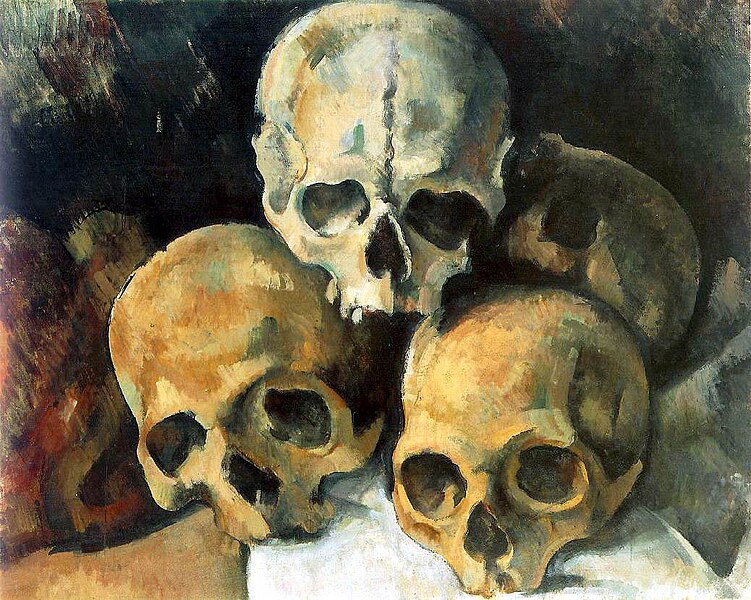 We may be coming up on Thanksgiving, but I've got Halloween on my mind. As a teacher, Halloween, like Christmas, is a holiday where I must tread with care. There are usually a few students whose parents have a real discomfort over Halloween, just as there are those who have issues with Christmas, generally due to religious reasons. I respect religious differences and therefore I try to walk a careful line around such holidays.
But this year, I found myself thinking about this reality, about why so many Christians take issue with Halloween. Actually, it's not just Christians. Many adults seem squeamish at the whole fascination with the evil and violent images that Halloween conjures.
Understandable feelings. Reveling in the dark side of existence can be bad for the soul. So, there may be a line that shouldn't be crossed. However, I would submit that acknowledging the darkness, and the power behind fear and violence and death, does not deny God or life. Even for those who believe in a life after death, death is a reality. The suffering, loss and grief of death are still real aspects of human life. Even Christ experienced them. True faith should not only be able to acknowledge death, and darkness and evil and fear, it should be able to incorporate them into a fuller, more complex understanding of existence. Perhaps by facing the creatures born in the darkest corners of our imaginations, and embodying those fears, we actually strengthen our souls' ability to endure and survive the frightening and dark parts of human existence.
At least, those are my thoughts on this cold and dark November evening.
Friday, February 8, 2013
Studying the Greatest Mystery
Death is an experience at once entirely universal and utterly personal. It comes in so many forms and nuances.
Death is the ultimate mystery. We might taste death's varied flavors from the outside many times during our lives, but we only experience it from the inside once. No one truly knows what that one and final moment is like. We try to understand it. We have stories of "near-death" experiences. If we sit vigil with someone who is dying, we watch for signs and signals that can send us some message about the journey. We attach meaning to the signs. We look for metaphors and significance everywhere, because we want so desperately to know what has happened to that person, and what will happen to us.
We must study death. We become deeper people by studying it. Since every one of our stories ultimately has this same ending, we are compelled, each in our own way, to try to understand this thing that we all must face.
Death is the ultimate mystery. We might taste death's varied flavors from the outside many times during our lives, but we only experience it from the inside once. No one truly knows what that one and final moment is like. We try to understand it. We have stories of "near-death" experiences. If we sit vigil with someone who is dying, we watch for signs and signals that can send us some message about the journey. We attach meaning to the signs. We look for metaphors and significance everywhere, because we want so desperately to know what has happened to that person, and what will happen to us.
I have been thinking about death recently because my family has been dealing with death. As we deal with this one death, we find ourselves revisiting other experiences of death in our lives. The sudden and unexpected deaths. The quiet deaths at home after a long life. The deaths we met when we were young and it was new. The deaths that came in cycles or came too early or too brutally. We strive to sift this one experience into the larger understanding of the great mystery.
We must study death. We become deeper people by studying it. Since every one of our stories ultimately has this same ending, we are compelled, each in our own way, to try to understand this thing that we all must face.
Monday, August 20, 2012
A Small Death
 The end of summer is a small death. As it draws near, inevitable regrets hover about me. Did I waste my time? Why didn't I do more, travel more? I should have finished that project. I should have gone to the beach again. I thought I had more time. I can still fit in one more fling. I want to be prepared for the end. I want to say my goodbyes.
As these thoughts gathered in my brain this morning, I wondered. If I feel this way at the end of summer, is it a taste of how I will feel at the end of life? I reminded myself that my life isn't over. It's just going to change. The end of summer brings new things to anticipate, new adventures. Perhaps that, too, is true for death.
Subscribe to:
Posts (Atom)