Wednesday, June 25, 2014
Finding a Kindred Voice
I just finished reading Leaving Church, by Barbara Brown Taylor and I found myself wanting to post in here, after a long time away. I came upon Ms. Taylor's name in an article in Time Magazine. Although her journey is very different from mine in many, many ways, it spoke to me and resonated at its core with a kind of quiet profundity. Her understanding of Christianity and God, and the humility and open-mindedness with which she explores that understanding, connected with me. Reading her story made me think back over my own journey and look at all its steps with reverence and affection. It made me want to reconnect with things from which I have drifted away. It renewed my desire to approach my job, my vocation, as a teacher with a sense of holiness, with the notion that my time in the classroom is a prayer and that teaching is how I serve God. When she described looking over her hymnals and the other items from her time as a rector, I found myself thinking warmly about my own well-worn Bible, with its note cards and papers tucked into the pages, and feeling so very grateful for all of the life experiences it held in its pages, moments great and small and most often profound. Ms. Taylor's book gave me a gift of seeing my journey through new eyes, and of knowing I am not alone in the "neither this nor that" it represents. I never lost my faith, but my faith changed and evolved. It is so hard to explain it clearly to someone else, and to read a book that spoke from such a similar place, to discover another voice that shared that perspective, was a great blessing. I'm posting about it here with the thought that it might be a blessing to someone else, too.

Saturday, February 1, 2014
The Quiet Echoes When Lives That Brush Against Us End
When I was in high school, I had one of those memorable teachers who made an indelible mark upon my life. Her name was Maureen O'Donnell. She did much more than brush against my life. But this post is not about her. Not really. It is about one of her former students, John Donahue. John was someone I knew of, but did not know well. She spoke highly of him, as if he was one of her children. That's how she treated all of us. I looked up to John. When John would come to visit Mrs. O'Donnell in the classroom, she would welcome him with open arms, and we knew that's how we would be welcomed, too, when our time came to be alumni who visited her. He was a sign of the continuity of the relationship, a hopeful reminder of the future.
When I was in college, Mrs. O'Donnell passed away. She was 58. Her former student, John Donahue, stepped in to the great gaping hole left by her absence to teach her class. I remember my heart flooding with relief when I learned that a member of the family, the family of her students, would be shouldering this daunting task. I was so grateful to John for that. He became, then, a symbol of both the future and past, once again representing the continuity of the bond Mrs. O'Donnell had created among her students.
A few weeks ago, John Donahue passed away, too soon, from the same cancer that took Mrs. O'Donnell. Although I did not know him well, his death has left strange and quiet echoes in my heart because he brushed my life. How often this seems to happen. When someone we only knew tangentially, whose existence in some way impacted us, though not deeply, dies, there is ... a something. A moment, like the moment of silent reverberation after a sudden loud sound in a deep and quiet wood, a moment of acknowledgment, where we stop and think and struggle to name the feeling in us that is not grief but is not indifference. This life that ended may only have nudged our course by the most infinitessimal of magnitudes. But science tells us that even the tiniest nudge can amplify over time.
This feeling is a deeper, more intimate shade of the sentiment expressed in the famous poem by John Donne, "No Man Is An Island," whose most well-known line ("Ask not for whom the bell tolls") has taken on an ominous connotation that does not do its context justice:
When I was in college, Mrs. O'Donnell passed away. She was 58. Her former student, John Donahue, stepped in to the great gaping hole left by her absence to teach her class. I remember my heart flooding with relief when I learned that a member of the family, the family of her students, would be shouldering this daunting task. I was so grateful to John for that. He became, then, a symbol of both the future and past, once again representing the continuity of the bond Mrs. O'Donnell had created among her students.
A few weeks ago, John Donahue passed away, too soon, from the same cancer that took Mrs. O'Donnell. Although I did not know him well, his death has left strange and quiet echoes in my heart because he brushed my life. How often this seems to happen. When someone we only knew tangentially, whose existence in some way impacted us, though not deeply, dies, there is ... a something. A moment, like the moment of silent reverberation after a sudden loud sound in a deep and quiet wood, a moment of acknowledgment, where we stop and think and struggle to name the feeling in us that is not grief but is not indifference. This life that ended may only have nudged our course by the most infinitessimal of magnitudes. But science tells us that even the tiniest nudge can amplify over time.
This feeling is a deeper, more intimate shade of the sentiment expressed in the famous poem by John Donne, "No Man Is An Island," whose most well-known line ("Ask not for whom the bell tolls") has taken on an ominous connotation that does not do its context justice:
No man is an island,
Entire of itself,
Every man is a piece of the continent,
A part of the main.
If a clod be washed away by the sea,
Europe is the less.
As well as if a manor of thy friend's
Or of thine own were.
Any man's death diminishes me,
Because i am involved in mankind.
And therefore never send to know for whom the bell tolls;
It tolls for thee.
Sunday, January 26, 2014
The Paradox of Age
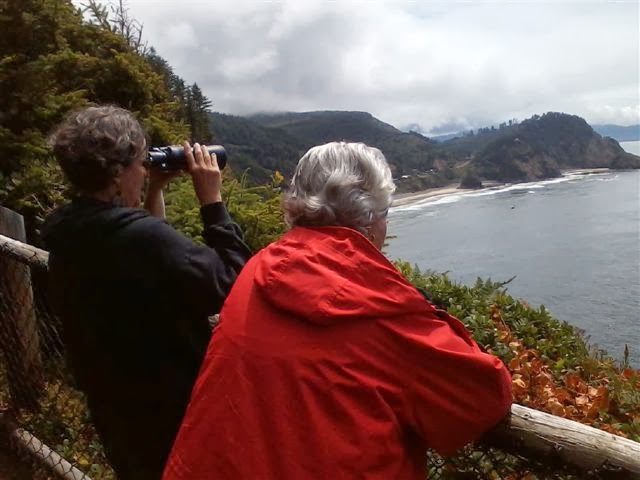
Full disclosure, I am 47, closing in on 48 (this week!). I sometimes feel like a dinosaur, though my older friends would, of course, dispute that fact. I have entered the stage of life when you fall effortlessly into lengthy conversations that begin with the words "Remember when." The impulse to reminisce seems very powerful at this point in my life. I engage in a lot of involuntary grunting and other vocalizations when I get up off the couch or out of the car. I'm in good shape, and yet I seem to have a variety of random injuries and odd health quirks that were never there before. Most of the time, in my head, I don't feel so very different from who I was when I was younger. Then something will happen that pulls me up short and reminds me how very different the view looks from here, and how very different the pilot of this ship called my body is now. The agitated struggle feels calmer, the reality of mortality more inevitable, the truth of physical limitations undeniable, the need for approval less insatiable, the warm glow of small joys burnished brighter by time.
Recently, there have been a spate of articles about various generations - Generation X, the Boomers, the Millenials, and other labels I haven't fully retained because I've come to the conclusion that they are just that - arbitrary labels. The sad thing about attempting to draw these careful generational distinctions is that it seems to be giving in to the worst of our human tendency to define, and segregate, ourselves by our differences. These generational articles all seem to amount to mud slinging from one generation to another.
I see it in myself, the way I sometimes get unreasonably annoyed by a new fashion trend (cutesy animal hats on adults, for example), or inestimably frustrated by a particular attitude of someone younger than me, or a younger person's failure to grasp or understand some part of who I am. It is the nature of youth to push, to question, to demand, to assume, to point out what it sees as the failings of the older generation, and to have knowledge gaps that prevent a full understanding of that generation. On the other hand, it is the nature of age to see youth from the outside and find fault in what is essentially a work in progress. The hard won knowledge and experience that comes from sticking around life long enough to reach middle age or old age is something we demand acknowledgment for, and burn to share. Meanwhile, the younger generation demands the chance to prove its strengths and talents, and craves the ability to strike out on its own and define itself separate from the influence of the elders, at the very moment when those elders most crave recognition and acknowledgment of their acquired experience.
How can these two sides ever come together? Really, truth be told, it's more than two sides. What we're talking about is a prism, a diamond, its many faces made up of the many different perspectives that come not only from different time periods but different circumstances and personalities. When we are able to let go of the us vs. them attitude and reach out across the gaps of years to connect with people from a wide range of ages, our lives can be so much richer. I envy and celebrate the incredible energy and optimism and can-do attitude of youth. I honor and rejoice in the depth of knowledge and the courage and wisdom only evident in seniors. I cannot help laughing and marveling at the special perspectives of children. My world is made better by the connections I have with people from every age.
Subscribe to:
Posts (Atom)